
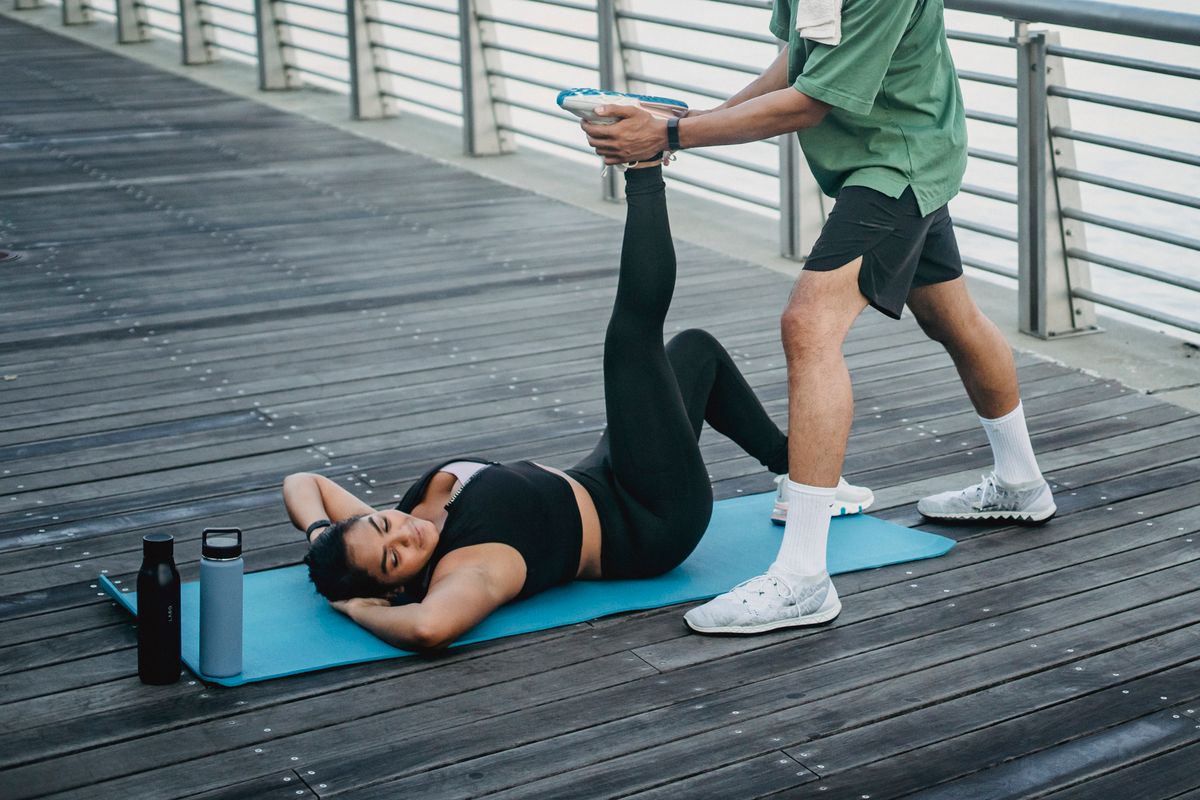
Assisted stretching pairs guided passive movement with brief, targeted muscle contractions — a method called PNF (proprioceptive neuromuscular facilitation). A practitioner takes each joint through its available range while you contract and release specific muscle groups, working with the nervous system's own reflex pathways rather than against them. PNF has long been positioned in the sports medicine literature as the most effective stretching technique for short-term gains in joint range of motion (Sharman et al., 2006); more recent meta-analyses find that a single session of any technique — static, dynamic or PNF — produces similar immediate gains (Behm et al., 2023), and that PNF and static stretching are comparably effective over weeks of training, both ahead of ballistic or dynamic stretching (Konrad et al., 2024). It has been studied from young athletes to older adults.
Book Assisted Stretching / PNF →PNF is positioned in the sports medicine literature as the most effective stretching technique for short-term gains in range of motion (Sharman, Cresswell & Riek, Sports Medicine, 2006) — an effect that review attributes not to reflex inhibition, which the evidence does not support, but to a change in how far a stretch is tolerated.
A dedicated review of PNF mechanisms found the effect extends past passive flexibility into actual muscular function — how a joint moves under load, not just how far it can be stretched (Hindle et al., Journal of Human Kinetics, 2012).
In a small pilot study of retirement-community residents in their late eighties, eight weeks of active-assisted stretching improved range of motion at most joints tested, along with gait speed, chair-stand and up-and-go performance (Stanziano et al., Clinical Interventions in Aging, 2009); a systematic review of flexibility training in older adults, however, found the evidence on everyday function still conflicting (Stathokostas et al., Journal of Aging Research, 2012).
Six weeks of regular stretching has been shown to reduce passive muscle-tendon stiffness (Murakami et al., Frontiers in Physiology, 2025). Increased local blood flow and faster clearance of metabolic by-products are often proposed as further mechanisms, but a 2025 meta-analysis of 15 trials found no measurable recovery benefit from post-exercise stretching, so we treat those as hypotheses rather than results (Zhang, Chen & Xing, Frontiers in Physiology, 2025).
Yes — PNF has long been positioned in the sports medicine literature as the most effective stretching technique for short-term gains in joint range of motion (Sharman, Cresswell & Riek, Sports Medicine, 2006), an effect linked to how far a stretch is tolerated rather than to any change in reflexes. A separate review of PNF mechanisms found the benefit extends past passive flexibility into actual muscular function — how a joint moves under load, not just how far it can be stretched (Hindle et al., Journal of Human Kinetics, 2012).
Not necessarily — more recent meta-analyses find a single session of any technique, static, dynamic or PNF, produces similar immediate gains (Behm et al., 2023), and that PNF and static stretching are comparably effective over weeks of training, both ahead of ballistic or dynamic stretching (Konrad et al., 2024). PNF's edge here is the guided, hands-on delivery, not outperforming static stretching on paper.
There's evidence for stiffness specifically: six weeks of regular stretching has been shown to reduce passive muscle-tendon stiffness (Murakami et al., Frontiers in Physiology, 2025). Claims about faster recovery through improved blood flow are common but not yet proven — a 2025 meta-analysis of 15 trials found no measurable recovery benefit from post-exercise stretching, so we treat that as a hypothesis, not a result (Zhang, Chen & Xing, Frontiers in Physiology, 2025). As with our other services, this is a general, well-researched effect rather than a promise of treatment for any specific condition.
Session length and frequency depend on what you're working on — a one-off for general tightness, or a more regular cadence alongside training or an ongoing mobility goal. Your practitioner talks through timing and frequency with you at your first visit rather than fixing it in advance.
The evidence is clearest on joint range of motion; the functional effects above rest on smaller or early-stage studies, and the circulatory effects remain a proposed mechanism rather than a demonstrated one — that is what we describe, and nothing more.
Shop 9, 100–102 Bay Road, Waverton NSW 2060 · 0467 467 567
Book via Fresha →